Today, we’ll have a quick look at Korea’s last kingdom, the Joseon Dynasty. This royal family governed the Korean peninsula from 1392 until 1910. Furthermore, they are responsible for no less than 3 world heritage sites in the centre of Seoul:
- the Changdeokgung Palace Complex,
- the Jongmyo Shrine, and
- the Royal Tombs of the Joseon Dynasty
Palace – shrine – graves
You can follow this royal clan from their temporal dwellings during their time on earth, continuing to where their souls rest eternal, and eventually ending up where their mortal remains are buried.
Let us begin with their home: where they lived, and from where they effectively ruled Korea for more than half a millennium.
World Heritage in Seoul 1: Changdeokgung, the Palace of Prosperous Virtue

Donhwamun Gate
Seoul has no less than five palaces. See one – or see them all. With limited time and freezing December temperatures, we opted for one: the oldest of the bunch, and arguably the best preserved. King Taejong had the Changdeokgung Palace built in 1405 – 1412, and for the next three centuries, this was the principal palace of the Joseon Dynasty.
We are in Seoul’s city centre, at the foot of the Eungbong Peak of Mount Bukaksan, one of the four mountains surrounding the Korean capital. Also known as Donggwol (the Eastern Palace), Changdeokgung was not merely a palace, but an entire complex – all 58 hectares (143 acres) of it – with several private and public buildings: both royal residences and administrative buildings for the affairs of state.
Today, 13 buildings remain, most notably Donhwamun Gate, and Injeongjeon Hall (the main hall with the royal throne).
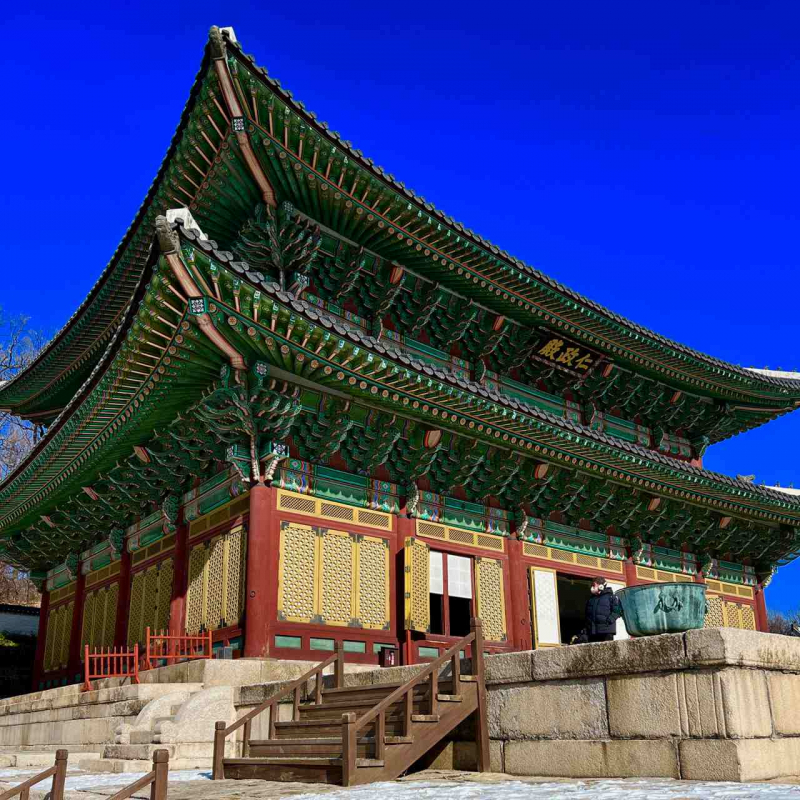
Injeongjeon, main hall

Inside Injeongjeon

The secret garden
At the back is Huwon Secret Garden, so named as it was available only for the royals to appreciate. They alone could wander around and admire the 28 elegant pavilions, the villas, the lily pond, the stone bridges, and not least, the more than 50,000 plants and trees, one of which is more than three centuries old.

Our exploration on this winter Sunday is all taking place outdoors, around the palace grounds. The buildings are for the most part empty, but you can still get an idea of the grandeur.

Almost 200 years after it was built, Changdeokgung Palace was burnt down, along with the rest of the palaces in Seoul during one of the many Japanese invasions of the country. It was rebuilt in 1610.
I love the first impression of this palace, and how it is built in harmony with the surrounding landscape. See how Donhwamun Gate beautifully frames the peak?


What’s in a name – and how to visit
Chang = prosperity; deok = virtue. Changdeokgung = the Palace of Prosperous Virtue.
- You can visit the palace freely, without a guide.
- Entrance: 3,000 won for a general admission ticket, plus a further 8,000 won for a guided tour around the Secret Garden.
- If you think you might want to visit all 5 (including the Jongmyo Shrine, see below), an integrated pass will save you a few thousand won.
- The site is closed on Mondays.
- You’ll find up-to-date opening hours and prices for Changdeokgung Palace here.
- If you want to brave Seoul’s somewhat confusing subway system, take Line 3 and get off at Anguk Station. Changdeokgung is a 5-minute walk away. Otherwise, taxis in Seoul are inexpensive, and for the most part easy to flag down.
In short, Changdeokgung Palace Complex is a very easy world heritage site to see. Also, you practically get two for one, as there is another site just across the street…
World Heritage in Seoul 2: Jongmyo Shrine
…and that brings us to the Jongmyo Shrine, where the souls of the long since departed Joseon kings and queens have resided since the 1400s. The Joseon Dynasty firmly believed in Confucianism. From 1634, this is the oldest and best-preserved Confucian shrine still in existence.

After Joseon kings and queens died, there would be a 3-year mourning period, after which their memorial tablets would be enshrined here.
This is also a place of ancestral rites, and memorial ceremonies with music, song and dance are performed annually for the departed royals, as it has been for 500 years. The most important ceremony, the Jongmyo Jerye, takes place the first Sunday in May. Significantly, it is organised by surviving members of the Joseon clan.
The site is essentially a walled park, with two large squares lined with buildings, designed to focus on the solemn and serious; the profound meaning of life and death. They are rather lovely in their simplicity.
And it is a peaceful place to wander. Just remember not to walk on the spirit path.

‘Please do not walk on this pathway. This is for the spirits.’
Jeongjeon is the main memorial building, and the longest traditional building in Korea, holding 19 spirit chambers which house memorial tablets detailing the teachings of 19 former kings and 30 queens.

Jeongjeon is being renovated at the moment, so our experience of the Jongmyo Shrine was quite limited. Thus, we will have to return, maybe to see the Jongmyo Jerye rituals in May. As an added bonus, UNESCO has made this ceremony part of its Masterpieces of Oral and Intangible Heritage of Humanity.
How to visit the Jongmyo Shrine
- We are here on a Sunday, so we simply buy an entrance ticket (1,000 won) and wander around on our own.
- On weekdays, tours are compulsory. Presently, tours are offered in English 4 times per day, at 10.00, 12.00, 14.00 and 16.00.
- Up-to-date info on times and prices are here.
- Jongmyo Shrine is closed on Tuesdays.
Near the shrine, are a few interesting little shops and cafes.
World Heritage in Seoul 3: Royal Tombs of the Joseon Dynasty
The Royal Tombs are located in another part of Seoul. In several other parts, as a matter of fact, as the 40 tombs are scattered over 18 sites, at scenic locations in and around Seoul.
As it happens, one cluster of graves, Seollung, is just around the corner from our Gangnam digs. Of the 18 sites, this is the most easily accessible one. Soon, in the midst of the skyscrapers, we stumble upon a peaceful forest, with ancient trees: pines, ginkgos, cherry trees. It would be lovely to see it in bloom.


Seollung has three royal grave mounds; King Seongjong and Queen Jeonghyeon are next to each other.


Left: The body of Queen Jeonghyeon rests here. Right: her husband, King Seongjong.
Further along is the tomb of King Jungjeong:

Not unexpectedly, the grave mounds are similar to the ones outside Kaesong in North Korea from the Koryo dynasty.
Additionally, associated buildings are scattered about: colourful, wooden shrines, guard’s houses, etc., reminding us once again to stay off the spirits’ way. Instead, we must stick to that of the mere mortals, ie. the king.


How to visit the Joseon Royal Tombs
- The forest with the grave mounds is close to Seollung subway station (Line 2, Exit 10).
- Entrance fee is 1,000 won.
- The Seollung site is closed Mondays.

Further reading about Korea on Sophie’s World:
Changdeokgung Palace Complex, Jongmyo Shrine and Royal Tombs of the Joseon Dynasty are all UNESCO World Heritage sites.
Here are more UNESCO World Heritage sites around the world.